Understand relationships and identify feedback loops within systems.
(理解系统内的关系并识别反馈回路。)
Connection circles are a tool for visualising relationships in a story or a system. They help you understand complexity by seeing causes and effects in the system.
(Connection circles 是一种将故事或系统中的关系可视化的工具。它们帮助你通过看到系统中的因果关系来理解复杂性。)
Connection circles can also help you identify feedback loops – whether reinforcing or balancing.
(Connection circles 也可以帮助你识别 Feedback loops (反馈回路 此处需要超链接),无论是强化或者平衡 )
How to create a connection circle (如何创建一个 Connection Circle)
Start with a circle on a piece of paper. (开始在一张空白的纸上画一个圆)
Next, identify the key elements of the system you're examining.(下面确认你所在系统的关键因素)
How do you know what's a key element? It meets these criteria:(你是如何确认他是关键因素呢?这些需要符合什么标准呢?)
It's important to changes in the system (关键因素它的变化对于系统来说是非常重要的)
Increases or decreases in the system (系统中的增加或者减少)
Can be described by a noun (关键因素可以用一个名词描述的)
Write these elements around the circle (don't include more than 10).(把这些关键因素写在环形四周,但是不要超过10个关键元素,这里包含10个关键元素)
Look for cause and effect.(寻找关键元素的因果关系)
Which elements are directly causing other elements to increase or decrease? (哪个关键元素直接导致其他元素的增加活着减少呢?)
Draw an arrow between these elements. (在这些关键元素间用箭头链接)
Indicate an increase (draw a "+") or a decrease (draw a "–") for the second element in each relationship.(指出每个关系中第二个元素的增加(画一个 "+")或减少(画一个"-"))
Find all of the cause-and-effect relationships. These can be based on data or they can be a hypothesis.(找到所有的因果关系。这些可以是基于数据的,也可以是一个假设。)
Look for elements whose relationships form closed loops. These are feedback loops. (寻找那些关系形成闭环的元素。这些是反馈环路。)
Example(例子)
It's best to illustrate with an example.
(这个模型最好用一个例子来说明)
Let's say our product has been dealing with unhappy customers.
(比如说:我的产品和那些满意度不高的顾客们之间需要处理的关系)
We know they've been complaining about too many bugs
(我们知道客户一直在抱怨产品存在太多的 Bug)
in the product and slow response times from our support (as customers create more support tickets).
(以及我的产品售后支持响应速度不迅速,导致客户提交了许多支持工单)
At the same time, we've been shipping more features to make them happier.
(同一时间,我们一直在增加更多的新的产品特性维持客户的满意度)
Let's use make a connection circle so that we can make sense of this.
(让我们画一个 Connection circle,这样我们就可以大致理解这个复杂系统下的主要特征了)
From this story, we can identify the key elements: unhappy customers,
(通过这个故事,我们可以确认的关键元素有:满意度不高的客户)
bugs in the product, response times, support tickets and new features.
(产品重的 BUG,问题反馈响应时间,支持工单 和 产品新特性)
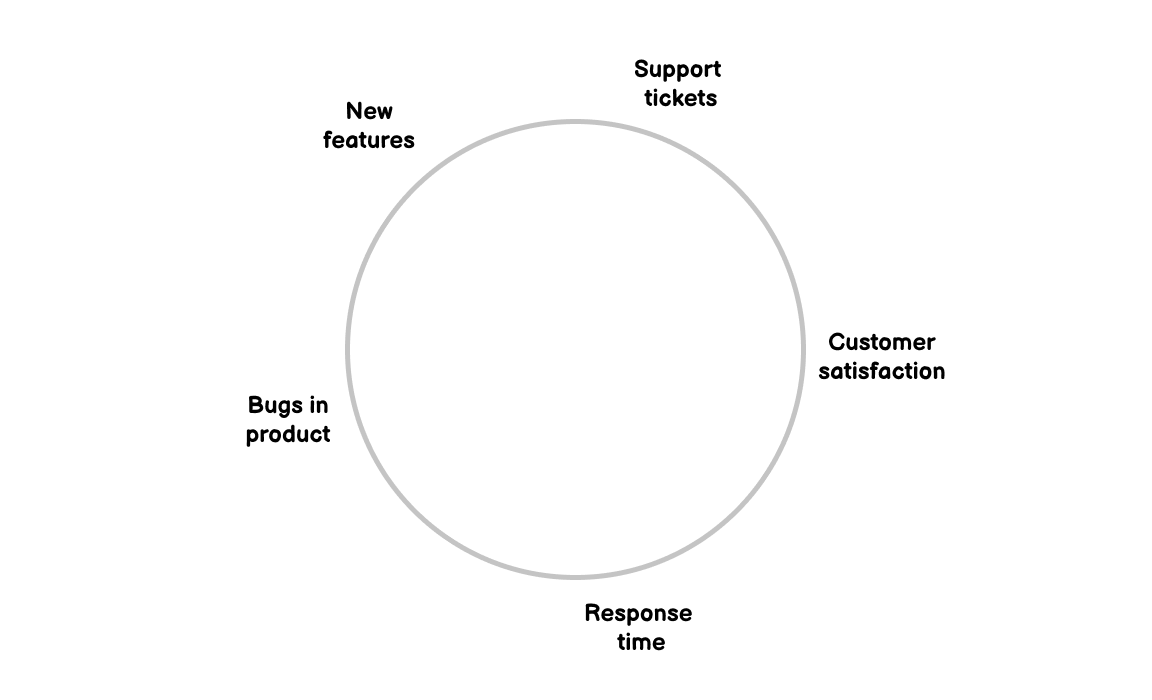
We'll document them around our connection circle:
(我们讲这些关键元素在 Connection circle 上记录下来)
Now we need to document the relationships between them.
(现在我们需要记录关键元素之间的关系)
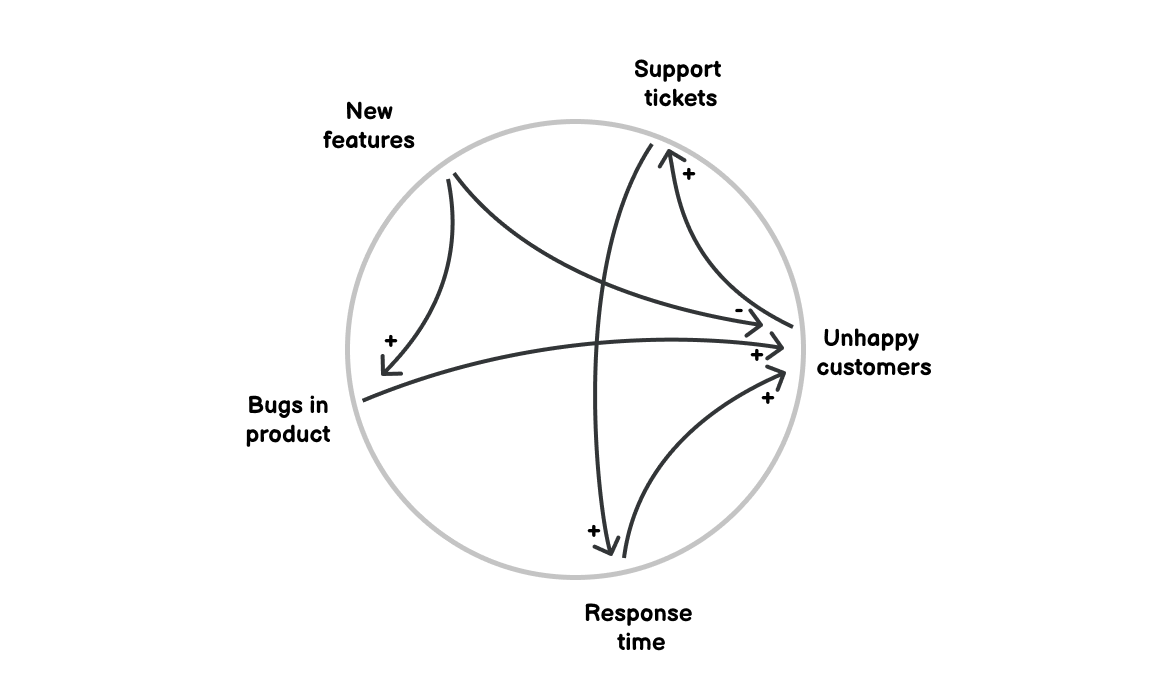
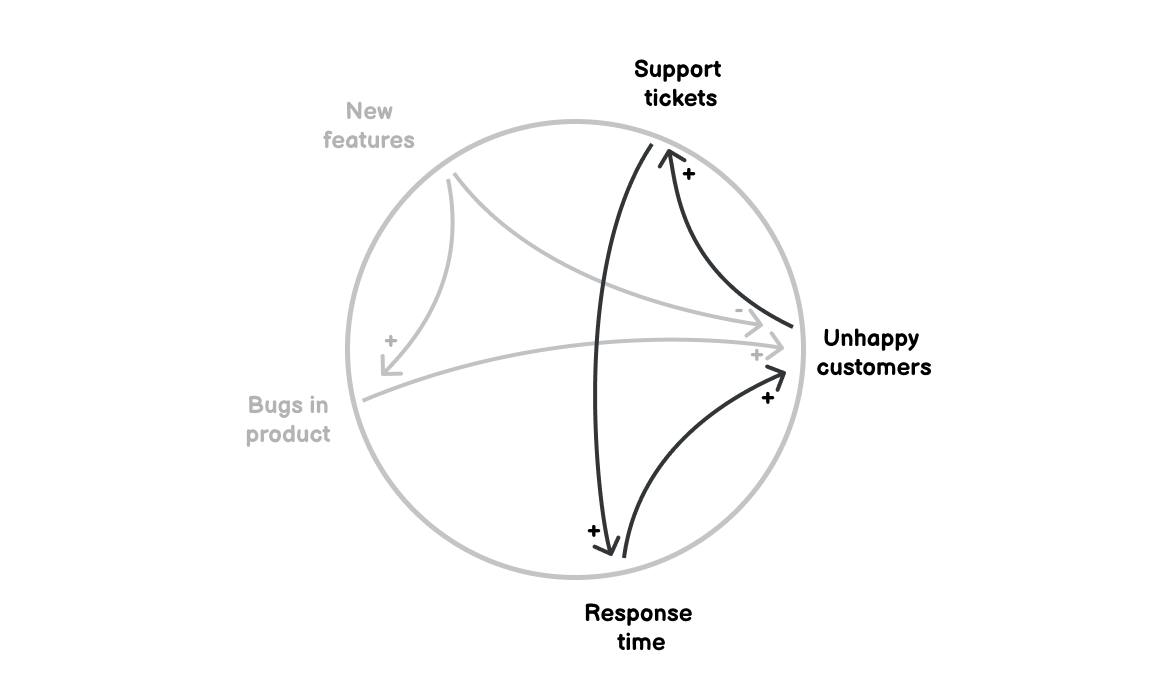
For example, we know that unhappy customers create more support tickets.
(比如,我们知道 不满意的客户创建了更多的支持工单)
More tickets means longer response time which in turn produces even more unhappy customers.
(更多的工单意味着会增加了售后支持的响应时间,反之因为售后支持的响应时间漫长,产生了更多的不满意的客户。ps:这是一个恶性循环)
We try to ship new features which lower the number of unhappy customers.
(我们试图通过增加新的产品特性来降低不满意客户的数量)
But they also produce more bugs and those lead to more unhappy customers again.
(但是新的产品特性会带来一些 新 Bugs 出现,这让对产品不满意的客户再次增加)
Let's map these relationships to the connection circle:
(让我们把这些关系映射到这个 Connection Circle中:)
The connection circle is now nicely showing
(现在这个 Connection circle 循环已经很好的展示出来)
the key elements of the system and the relationships between them.
(这个系统的关键因素以及他们之间的关系了)
There's even one feedback loop that we can see here:
(我们可以看到这里甚至有一个 FeedBack loop 在这里 )
The completed connection circle and an identified feedback loop make you better understand the system.
(一个完整的 Connection circle 和 一个确定的 feedback loop 会让你更好的理解当前的系统环境 )
This understanding will greatly help you make changes that you need.
(这种理解将极大地帮助你做出你需要的改变。 )
Takeaway(要点)
Connection circles is a great tool for understanding systems.
(Connection circles 对于理解系统来说是一个非常好的工具)
It's about identifying key elements and mapping the relationships between them.
(这是关于确定关键因素和对他们之间的关系进行映射)
This tool can help you identify feedback loops as well.
(这个工具可以帮助你更好的确认 feedback loop(反馈循环))
(ps:才处理关系得时候也可以用,比如情侣之间的吵架)
Iceberg Model 冰山模型
Uncover root causes of events by looking at hidden levels of abstractions.
目的:(通过观察隐藏的抽象层次来揭示事件的根本原因。)
Addressing problems only on their event level is often not enough.
(只针对事件本身解决问题往往是不足够的)
The real causes are often hidden from plain sight.
(事件的真相往往隐藏在人们的视线之外。)
Iceberg model is a tool that allows you to shift your perspective
(Iceberg Model 模型工具可以帮助你转换观察视角)
and see beyond the immediate events that everyone notices.
(并且透过事件看到众人们没有注意到的事情。机器翻译)
It helps you to uncover root causes of why those events happen.
(它帮助你发现这些事件发生的根本原因。 )
That's possible by looking at deeper levels of abstraction within the system that are not immediately obvious.
(这可以通过观察系统内不太明显的更深层次的抽象而实现。机器翻译)
How to use it (如何使用它)
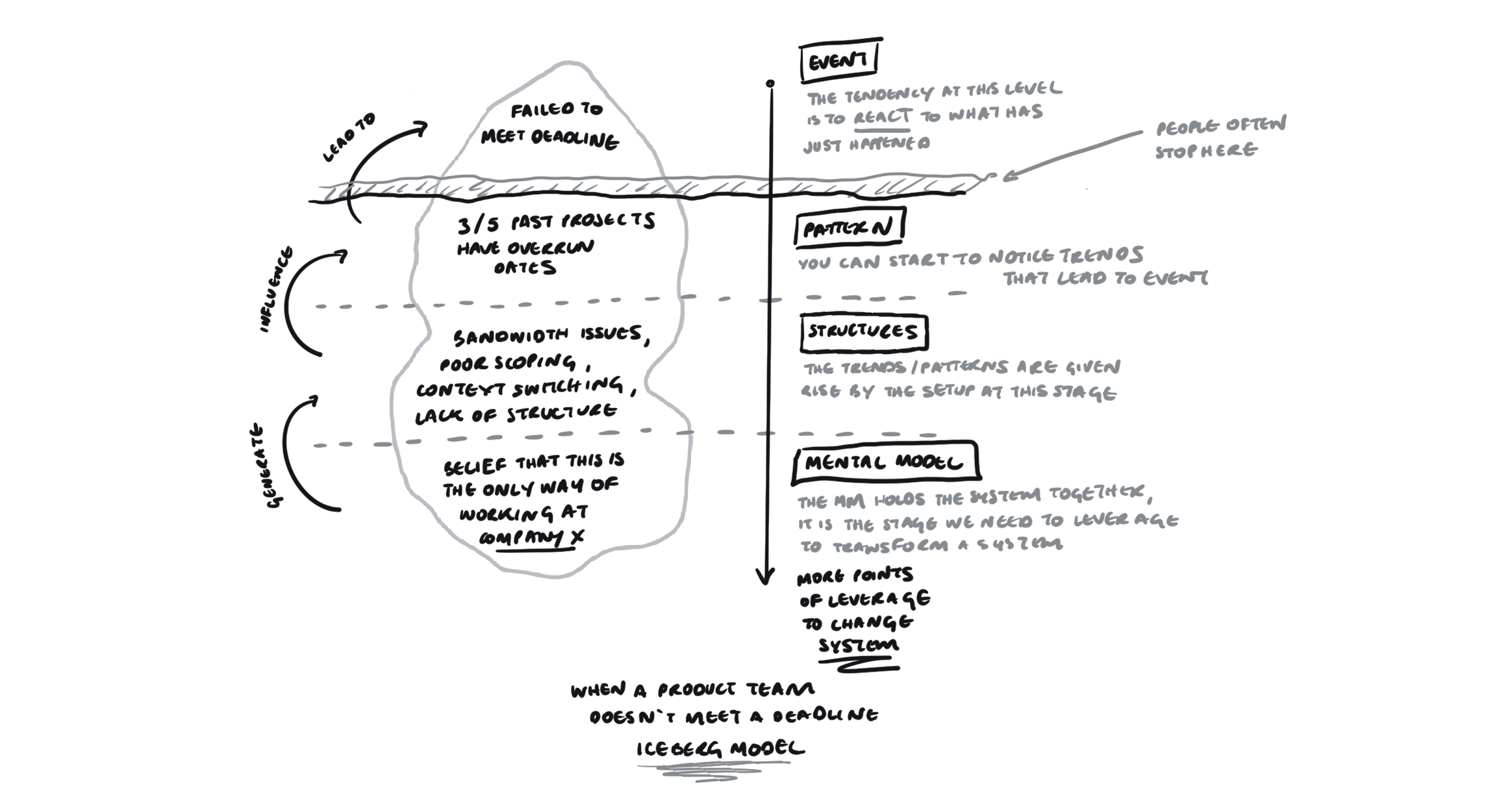
Iceberg model consists of four levels:(冰山模型由四个层次组成:)
Events(事件)
Patterns(模式)
Structures (结构)
Mental models (心理模型 心智模型是否更好?)
(图片模型需要翻译)
Looking below individual events,
(在单个事件下)
you can see trends over time—patterns.
(你可以看到时间模式下的事件趋势)
They are the clue for understanding the system structures that are behind those patterns.
(它们是理解这些模式背后的系统结构的线索。)
Structures are the relationships and feedback loops inside a system.
(结构是一个系统内部的 关系 与 反馈回路 。机器翻译)
These structures are in turn based on the underlying mental models of people.
(这些结构又是基于人们的基本心智模式。)
Events and patterns show you what is happening.
(事件和模式会告诉你什么事情可能会发生)
Structures and mental models tell you why it's happening.
(结构和心智模型会告诉你这件事为什么会发生)
The deeper you can go in the iceberg, the more leverage you'll have.
(你能在冰山上走的越深,将会有更多的判断条件)
Investigate all four levels (调查所有四个层面)
Here are some questions to help you understand each level within a certain problem or situation.
(这里有一些问题可以帮助你了解某个问题或情况下的每个层次。)
Events:(事件)
What is happening right now?(现在正在发生什么?)
Patterns:(模式)
What has been happening over time? What are the trends?(随着时间的推移,已经发生了什么事件?事件的趋势是什么?)
Structures:(结构)
What's influencing these patterns?(是什么在影响这些模式)
Where are the connections between patterns?(模式之间有什么联系?)
Mental models:(心智模型)
What values, beliefs or assumptions shape the system? (哪些价值观,信仰或假设形成了这个系统)
It's important to note that answering these questions
(值得注意的是回答这些问题)
will likely require some research and digging.
(将可能需要一些研究和挖掘)
Especially when it comes to the mental models which are hard to document,let alone see in plain sight.
( 特别是当涉及到心理模型时,这些模型很难被记录下来,更不用说在明处看到了。)
Example of the Iceberg model by Justin Farrugia
Example (举个栗子)
Let's look at a real-world example to better understand how the iceberg model works.
(让我们看看一个真实的例子,以更好地理解冰山模型的工作原理。)
Suppose there are a couple of bugs in the feature your product team just released.
(假设你的产品团队刚刚发布的功能中有几个bug。)
That's a single event. Your instinct might be to react to it and start fixing them.
(这是一个单一的事件。你的本能可能是对它做出反应并开始修复它们。)
That's obviously not enough if you want to prevent it from happening in the future.
(如果你想防止它在未来发生,这显然是不够的。)
If you look back in time, you see that every released feature comes with several bugs.
(如果你回顾一下时间,你会发现每一个发布的功能都会伴随着几个bug。)
That's a pattern. Digging deeper, you find that teams don't plan for testing before releasing a feature.
(这是一种模式。深入挖掘,你会发现团队在发布一个功能之前并没有计划进行测试。)
The QA only happens after a release. Teams also typically have tight deadlines to ship a feature.
(QA质量管理只发生在发布之后。团队通常也有很紧的最后期限来发布一个功能。翻译不佳)
These are structures of the system.
(这些都是系统的结构。)
Investigating further, you discover that teams value shipping on time over the quality of their work.
(进一步调查后,你发现团队对能够准时发布的重视程度超过了他们对工作质量的把握。)
The tight deadlines are imposed by managers and teams believe it's not their place to push back.
(紧迫的最后期限是由管理人员规定的并且团队认为这不是他们的职责所在。)
As you can see, by looking beyond immediate events,
(如你所见,透过眼前的事件)
you are able to find a root cause of a problem.
(你能够找到问题的根本原因)
You now have much more leverage for solving the problem.
(你现在有更多的分析条件去解决这个问题)
Balancing feedback loop 平衡反馈回路
Mechanism that pushes back against a change to create stability.
(对变化进行反推以创造稳定的机制。Connection circles)
Balancing feedback loop is a mechanism that resists further changes in one direction.
(平衡反馈回路是一种机制,它抵制在一个方向上的进一步变化。)
It counters change in one direction with a change in the opposite direction.
(它以反方向的变化来对抗一个方向的变化。)
It seeks to stabilize a system.
(他试图稳定一个系统)
Often in systems, you will find this balancing loop together with the reinforcing feedback loop,
(通常在系统中,你会发现这种平衡回路与强化反馈回路 一起出现。 )
which does the opposite and creates exponential changes.
(后者的作用正好相反,会产生指数性的变化。)
How balancing loops work (平衡回路的工作原理)
Balancing feedback loops have three important components:(平衡反馈回路有以下三个部分组成)
the goal or desired level (目标或者预期水平)
the actual level (实际水平)
the gap between those two (两个水平之间的差距)
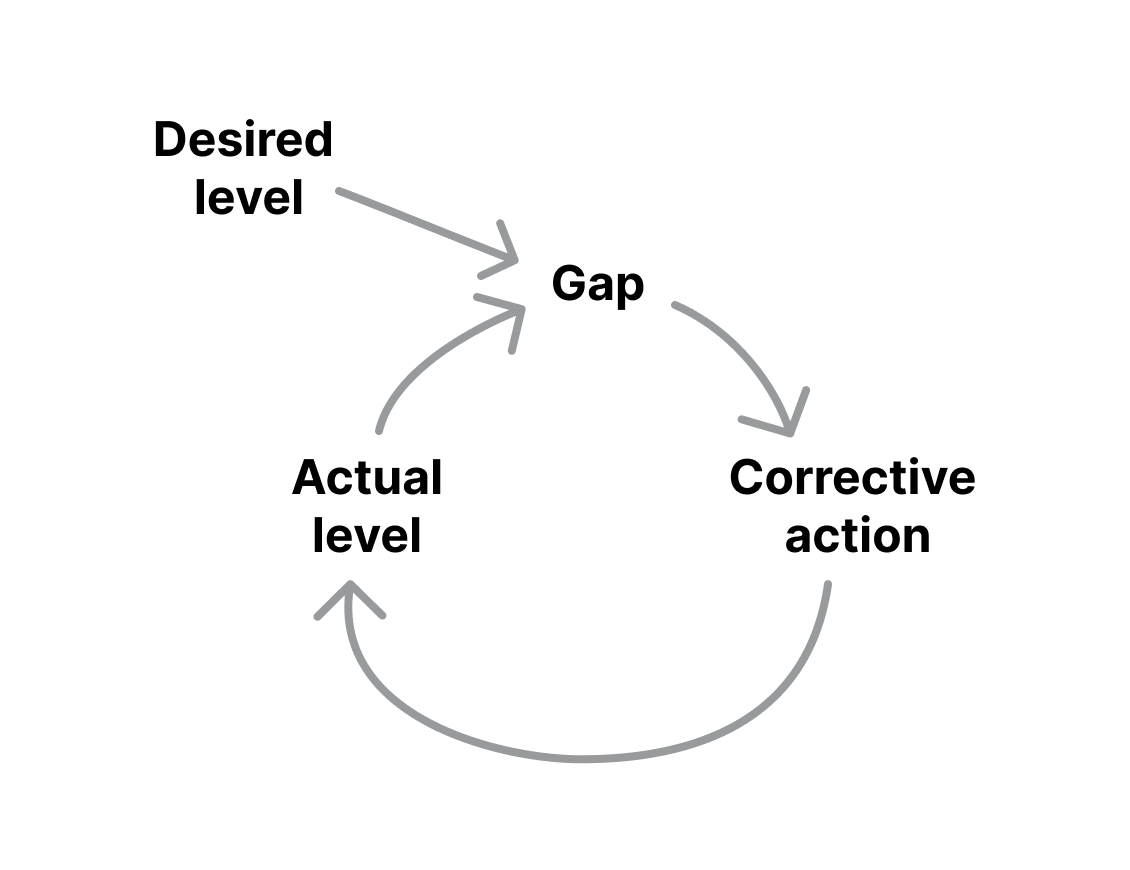
When the balancing loop sees a gap,
(当在平衡回路中发现一个缺口时)
it will trigger corrective actions to bring the actual level of something closer to the desired level.
(它将触发纠正措施,使实际水平接近预期水平)
The key to understanding a specific balancing loop is finding out its goal.
(了解一个具体的平衡回路的关键在于找出它的目标)
That may not always explicit or immediately visible.
(这可能并不总是很明确或者能够立刻发现它)
Example
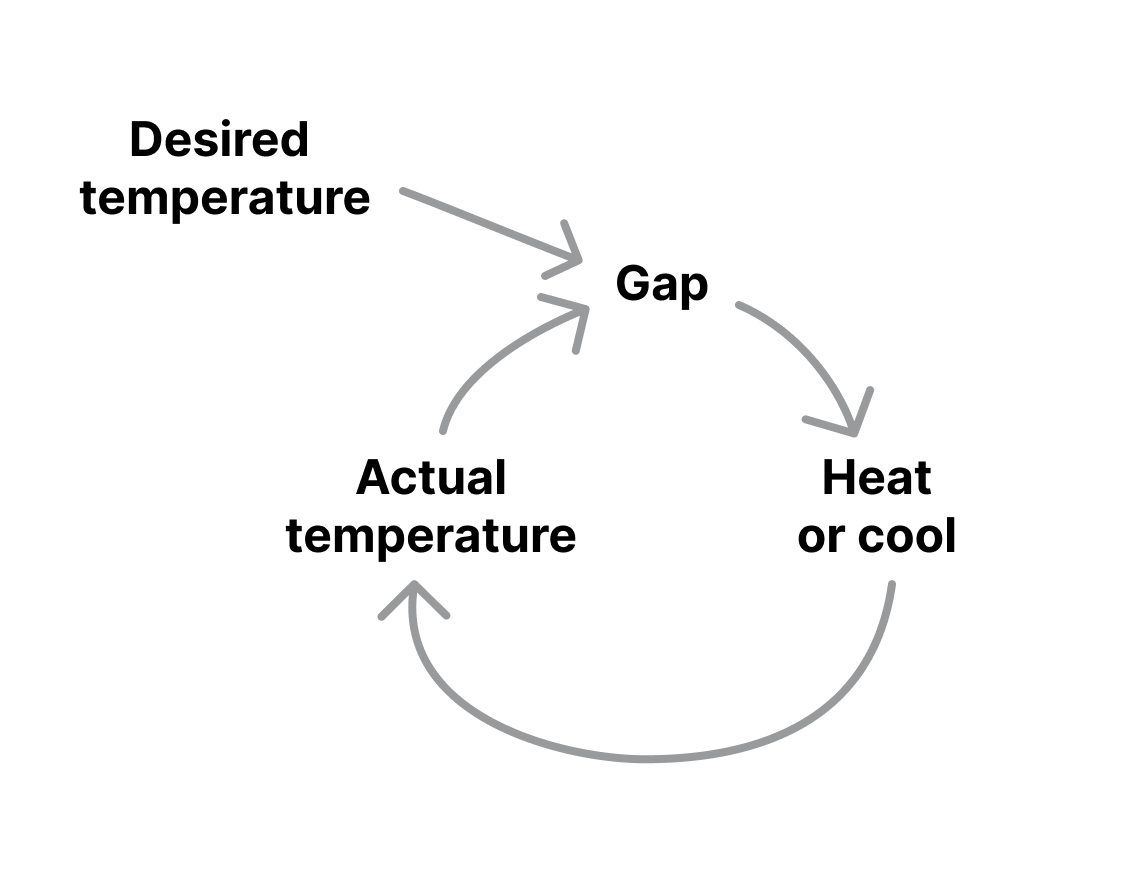
The thermostat is a very practical example of a balancing feedback loop.
(温控器是一个非常实用的平衡反馈回路的例子。)
It monitors the temperature in a room (the actual level) and
(它监测房间里的温度(实际水平),)
when it goes below or above a certain threshold (the desired level),
(当它低于或高于某个阈值(期望水平)时,)
it will start to heat or cool the room to keep the temperature within the thresholds.
(它将开始加热或冷却房间,以保持温度在阈值之内。)
In this case, the whole loop is intentional and the corrective action is designed.
(在这种情况下,整个循环是有意为之,并设计了纠正行动。 )
You will also find many natural balancing loops.
(你还会发现许多自然的平衡循环。 )
Take the cooling of tea for example.
(以茶的冷却为例。 )
When you make tea and leave it be,
(当你泡茶并让它静止时。 )
it will gradually cool down from its initially high temperature (the actual level) until it reaches the room temperature (the desired level).
(它将逐渐从最初的 高的温度(实际水平),直到它达到室温(理想水平)。 )
In this case, the corrective action would be the heat transfer
(在这种情况下,纠正措施将是茶叶和周围空气之间的热传递。 )
between the tea and the air around.
(这杯茶 和 周围空气之间的热量转移。 )
This will happen naturally, there's no intention behind it.
(这将自然而然的发生,背后没有任何意图。)
Takeaway
Balancing feedback loops seek to stabilize systems.
(平衡反馈回路需求稳定系统。)
They trigger corrective actions to reach a certain goal – they're self-correcting.
(它们触发纠正行动以达到某个目标--它们是自我纠正的。 )
They are the opposite of the reinforcing feedback loops, which produce exponential changes.
(它们与产生指数变化的强化反馈环路相反。)
Understand the force behind exponential changes.
(了解指数型变化背后的力量。关联 Connection circles)
Reinforcing feedback loops are found whenever behaviours
(当循环内的行为或事件相互加强时,就会发现强化反馈循环。)
or events inside the loop reinforce one another.
(或者循环回路内的事件相互加强)
These loops amplify the effect of the process.
(这些回路放大了过程的影响)
That's a mouthful, but you can find real-world examples all around you.
(这是一个口述概念,但你可以在你周围找到现实世界的例子。)
The compound interest is a very common one. The more money you have in the bank,
(比如复利是很常见的一种强化反馈回路。你在银行存的钱越多,)
the more you earn on interest. That money is added to your balance and so you earn on interest even more.
(你赚的利息就越多。这些钱会加到你的余额中,所以你的利息收入就更多。)
Effects of reinforcing feedback loops are exponential, not linear.
(强化反馈回路的影响是指数级的,而不是线性的)
They lead to exponential increases or decreases,
(他会导致指数级的增长或者减少)
whereas balancing feedback loops lead to plateaus – their goal is stability.
(然而平衡反馈回路会导致 高原反应 这个翻译不准确- 他们的目标是稳定的)
Often, these two loops exist together within a system.
(通常, 这两个反馈回路在一个系统中同时存在)
How reinforcing feedback loops work (强化反馈回路是如何工作的呢?)
The basic characteristic of all feedback loops is that the output of one cycle is the input for the next cycle.
(所有的反馈回路的基本特征是,一个周期的输出是下一个周期的输出,{此处想到项目经理的的 输入 工具 数据 ITTO 图})
In the case of reinforcing loops, this input amplifies the next output.
(在强化回路的情况下,这个输入会放大下一个输出.)
Inside the loop, there are at least two variables. These variables reinforce each other.
(在反馈回路里面至少有两个变量,这些变量相互加强。)
However, there can be also external variables that influence the loop.
(然而,也可以有影响循环外的变量)
It's best to illustrate this with a simple example.
(最好用一个例子来说明这一点)
Example (举一个例子)
The compound interest is a very common example of a reinforcing feedback loop.
(投资复利是一个非常常见的强化反馈回路的例子)
The more money you have in a bank account, the more you earn on interest.
(你在银行账号中的钱越多,你的挣到的利息收入越多)
That money is added to your balance and so you earn on interest even more later on. The cycle repeats.
(这笔钱利息收入存入到你的余额中,所以你以后回赚更多的利息。循环往复。)
In this example, you have two variables inside the loop: the balance on the account and the interest earnings.
An external variable influences this loop – the interest rate.
(在这个例子中,在你的循环内存在两个变量:账户余额和利息收入。一个外部变量影响着这个循环--利率)。
This variable will influence the output of the feedback loop but doesn't change the core mechanism of the loop.
(这个变量将会影响反馈回路的输出,但不改变回路的核心机制)
Takeaway
Reinforcing feedback loop is a key tool for understanding systems because it's everywhere.
(强化反馈回路是一个理解系统的关键工具,因为他无处不在。)
It explains exponential changes.
(它解释了指数性质的变化)
In reality, systems are often made up of some combination of reinforcing feedback loops and balancing feedback loops,
(在现实中,系统往往是由强化反馈环路和平衡反馈环路的某种组合构成的,)
so it's useful to learn about both.
(因此,学习这两种环路是很有用的。)
Make sense of different situations to choose an appropriate response.
(对不同的情况作出判断,以选择适当的反应。)
Different situations typically require different responses.
(不同的情况通常需要不同的反应。)
The Cynefin framework (pronounced /kəˈnɛvɪn/ - "kuh-nev-in") is there
(Cynefin框架(发音为/kəˈnɛvɪn/ - "kuh-nev-in")在这里)
to help you make sense of the situation in front of you
(是用来帮助你了解你面前的情况)
and make a decision that's appropriate for the type of situation you're dealing with.
(,并做出适合你所处理的情况类型的决定。)
It was developed by Dave Snowden in 1999.
(它是由戴夫-斯诺登在1999年开发的。)
How to use it
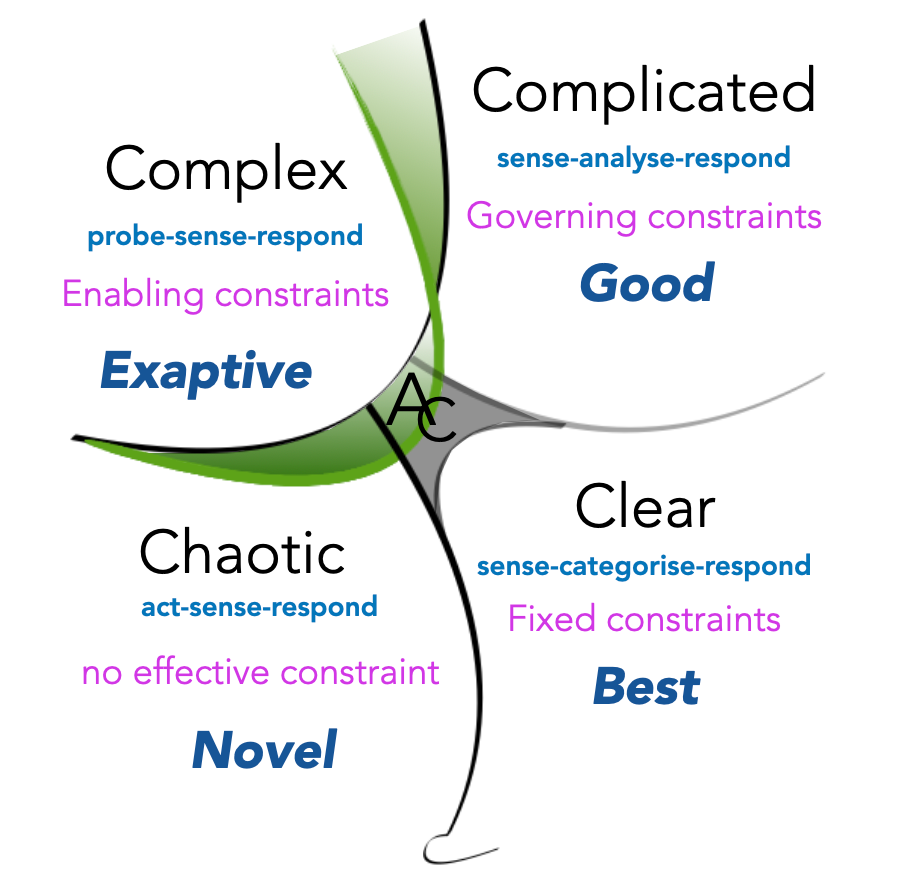
The framework identifies five domains to categorise problems or situations:
(这个框架确定了五个领域对问题或者情况进行分类)
clear, complicated, complex, chaotic and disorder.
(清晰的,事物,系统或过程的复杂,状态或处境,也用以描述人和生物的复杂,混乱的和无序的)
The idea is to identify which domain you're in and then choose the appropriate
(这个想法是要确定你处于哪个领域,然后根据其特点选择适当的行动。)
action based on its characteristics. So let's look at each domain in detail.
(基于其特点的行动。因此,让我们详细了解一下每个领域。)
Clear (清晰领域)
Also known as obvious or simple, this is the domain of best practices.
(也可以理解成明显或者简单,这是最佳实践的领域)
This is where problems are familiar and clearly defined,
(这是对问题熟悉和明确的定义)
cause-and-effect relationships are clear and the situations are stable.
(因果关系是明确的,情况是稳定的)
Many process-oriented situations and problems would fall into this domain. It's a domain of "known knowns".
(许多面向过程的情况和问题都属于这个领域,这是一个"已知的已知"的领域)
Solutions are usually clear in these situations and don't require much expertise.
(在这些情况下,解决方案通常已经非常明显并不需要太多的专业知识)
The right approach would be sense–categorise–respond: understand the situation (sense),
(正确的方法应该是 感知-分类-回应:了解局势情况(感知))
categorize it, then respond by applying a best-practice solution.
(对其进行分类,然后通过应用最佳实践解决方案进行回应。)
Complicated (过程复杂领域)
In this domain, there might be multiple right answers but aren't immediately visible.
(在这个领域,可能存在多个正确答案,但是那些不是能够立刻发现的。)
It's a domain of "known unknowns" – when questions are clear but it takes work to answer them.
(这是一个 "已知未知数 "的领域--当问题很清楚,但要回答它们需要付出努力。 )
That's why the best approach is to sense-analyze-respond. Because analysis is needed,
(这就是为什么最好的方法是感知-分析-回应。因为需要分析。)
the situations here typically require expert knowledge. Experts should assess the situation,
(这里的情况通常需要专家知识。应该通过专家评估情况)
investigate possible options and choose a course of action.
(调查可能的选项并选择行动方案。)
Complex (事物状态复杂领域)
In this domain, there are "unknown unknowns". The situation cannot be understood by analysis
(在这个领域,存在着"未知的未知"。这种情况不能够通过分析来理解)
because we don't yet know enough about it. It's not clear what needs to be answered in the first place.
(因为我们没有对他有足够的了解,它不能够清楚首先需要了解的问题是什么。)
So the right approach is to experiment first, learn about the problem.
(所以正确的做法是首先做实验,学习了解具体的问题)
Then sense what you're dealing with and respond appropriately.
(然后感知你正在处理的问题并作出适当的反应)
The goal should be to understand enough so that the problem
(首要目标是足够了解问题的信息,从而使问题或者)
or situation moves to the complicated domain where it's easier to deal with.
(局势转移到更容易处理的过程复杂领域中去)
Chaotic 混乱
When things aren't under control, the situation falls into the chaotic domain.
(当事情不受控制时,局势就会落入混乱的领域中)
It's when cause and effect relationships are unclear.
(这是在当因果关系不明确的时候)
Here it's necessary to first act to establish some stability,to contain the situation.
(在这里有必要首先采取行动,建立一些局势的稳定性,以控制局势。)
Only then assess the situation and work on bringing enough order to it to move it into the complex domain. Act–sense–respond.
(然后再评估局势,努力为其带来足够的秩序,使其进入复杂领域。行动-感知-反应。)
The chaotic domain also presents an opportunity to try novel solutions
(混乱领域也提供了一个去尝试新的解决方案的机会)
as people might be more open to them in this context.
(因为在这种情况下,人们可能会对它们更加开放)
###Disorder 无序
If you don't know where you stand, you're in the disorder domain.
(如果你不知道你所处的领域,那么你现在处于无序领域)
The goal should be to quickly identify the right domain and move forward from there.
(当前目标应该是快速确定正确的领域,并向那个领域推进。)
It can be helpful to break down the problem or situation into multiple parts and assign each to a specific domain.
(将问题或情况分解成多个部分,并将每个部分分配给一个特定的领域,这可能会有帮助。)
###Determining which domain you're in 确定你所处的领域
It's best to get more familiar with each domain to learn
(最好对每个领域加以学习熟悉)
when characteristics of a problem/situation apply to a particular domain.
(当一个问题/情况的特征适用于一个特定的领域。)
The sources below are a good place to start.
(下面的来源是一个很好的开始。)
Here's a set of questions that can also help point you to the right domain:
(这里有一组问题,也可以帮助你指向正确的领域。)
Do you know what causes the situation?
(你知道是什么原因导致了这种情况吗?)
Is the situation under control?
(情况是否得到控制?)
How much do you know about it?
(你对它了解多少?)
Does solving it require expert knowledge?
(解决这个问题是否需要专家知识?)
Takeaway
The key idea of the Cynefin framework is that different kinds of situations or problems require different kinds of responses.
(Cynefin 框架的关键思想是:不同种类的情况局势或问题需要不同种类的反应。)
You should identify what kind of a situation you're dealing with and—with the help of this framework—choose an appropriate response.
(你应该确认你正在处理什么样的情况或者局势,并在这个框架的帮助下选择一个适当的反应。)
Look at a decision from different perspectives
(从不同的角度来看待一个决定)
Making the best decisions often requires looking at them through different lenses
(作出最好的决定往往需要通过不同的角度去看待他们,)
so that you don't overlook an important aspect.
(这样子你就不会忽视一些重要的方面)
Six Thinking Hats,created by Edward de Bono,
("六顶思考帽 是由爱德华-德-波诺创建的)
is a tool for doing exactly that.
(正是这样一种工具)
You can use it for your own thinking or in a group where everyone can represent a different perspective.
(你可以把它用于你自己的思考,或者在一个小组中,每个人都可以代表不同的观点。)
###How to use it
Each thinking hat represents one lens/perspective/style of thinking.
(每一顶帽子都代表一种思考的镜头/视角/风格)
Try "wearing" different hats and look at the decision through each.
(尝试带上不同的帽子,并透过他们去看待这个决定)
If you're in a group, you can assign the hats to everyone to get a balanced discussion.
(如果你是在一个小组里,你可以把帽子分给每个人,已获得均衡的讨论)
Or you can go through different perspectives as a whole group.
(或者你可以作为一个整体去看待不同的观点)
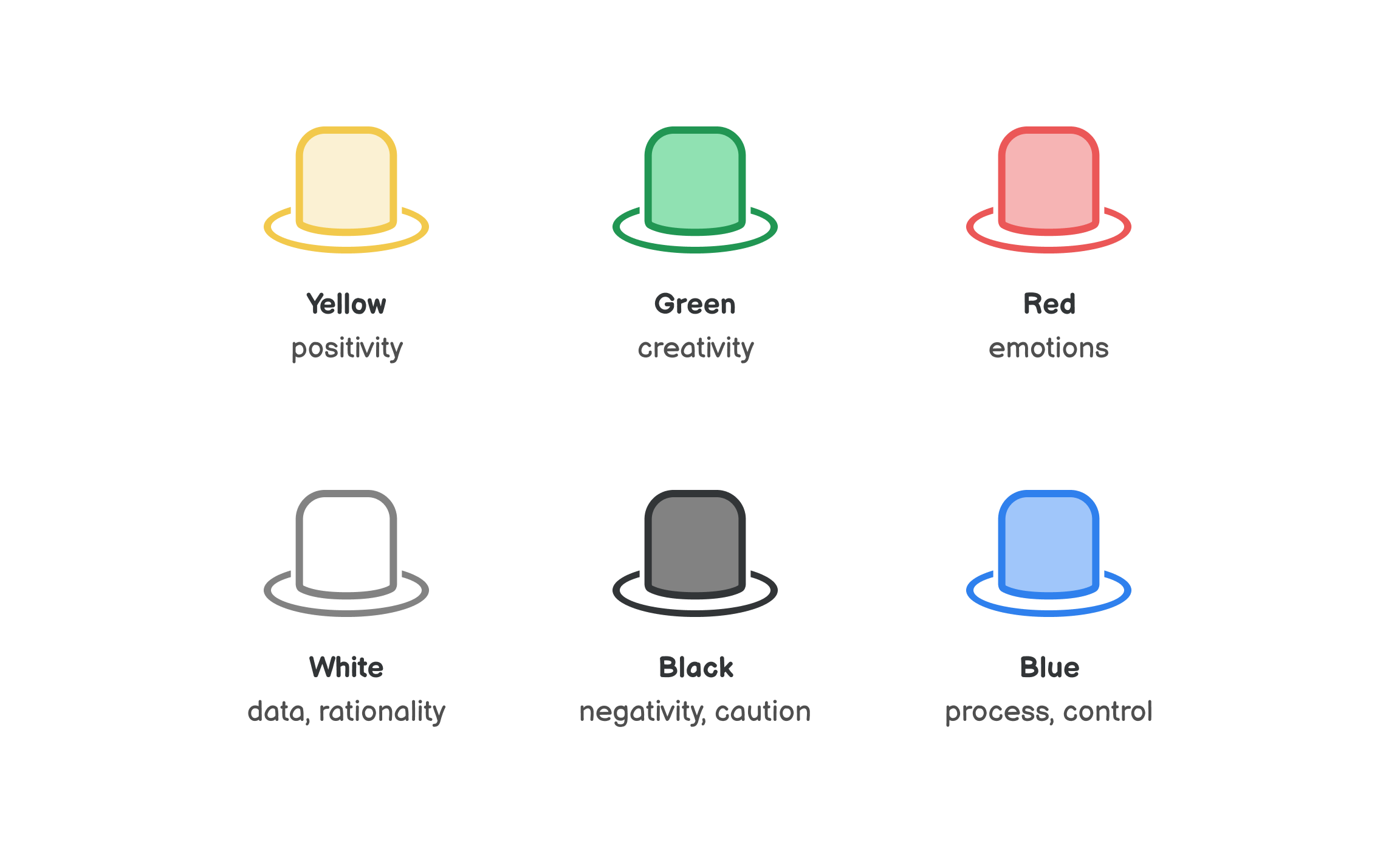
Here's what each hat is about:(以下是关于每个帽子思考的内容)
🟡 Yellow hat is about positivity. Try seeing the benefits of this decision and what opportunities it opens.
(🟡 黄帽子是关于积极性的。试着看到这个决定的好处,以及它所带来的机会。)
🟢 Green hat represents creativity. Let your mind run free and generate ideas without censoring them.
Try coming up with creative options and solutions.
Tools like the Productive Thinking Model or First Principles can help you.
(🟢 绿帽子代表创造力。让你的思想自由驰骋,产生想法而不加以审查。试着想出有创意的方案和解决办法。
生产性思维模式或第一原则等工具可以帮助你。)
🔴 Red hat is about emotions. How do you feel about this? Use your intuition and gut feelings.
Try to see how others might react emotionally. It's a great way to bring emotions into an otherwise rational process.
(🔴 红帽子是关于情感的。你对此有什么感觉?利用你的直觉和直觉。试着看看别人可能会有什么情绪上的反应。这是一个将情感带入其他理性过程的好方法。)
⚪️ White hat makes you focus on the data. Analyze the available data and trends. This represents a very rational approach.
(⚪️ 白帽子使你专注于数据。分析现有的数据和趋势。这代表了一种非常理性的方法。 )
⚫️ Black hat represents looking at the downside. What are the worst-case scenarios? Take a defensive approach,
imagine any potentially negative outcomes, see what might not work. Inversion might be a helpful tool here.
(⚫️ 黑帽代表着眼于负面的情况。最坏的情况是什么?采取防御性方法。想象任何潜在的负面结果,看看什么可能不奏效。在这里,反转可能是一个有用的工具。)
🔵 Blue hat is for controlling the process. Especially in meetings,
it's good to be able to step in when there's no progress and enable
the group to move forward (e.g. by shifting the thinking or discussion to a different hat/perspective).
(🔵 蓝帽子是用来控制过程的。特别是在会议上。特别是在会议中,能够在没有进展的时候介入并使进展的时候能够介入,使小组能够继续前进(例如,通过将思维或讨论转移到不同的帽子/角度)。)
###Example (举个例子)
Let's see how using this tool might play out in an example scenario.
(让我们看看在例子中如何使用这个工具。)
Suppose you're in a management meeting to decide if you should introduce a new product to your portfolio to battle declining sales.
(假如你在一个管理会议上决定是否应该在你的产品组合中引入一个新产品,以应对不断下降的销售。)
You use the Six Thinking Hats tool to make sure the decision is considered from all possible angles.
(你使用 "六顶思考帽 "工具来确保从所有可能的角度考虑这个决定。)
Starting with the yellow hat, you discuss the sizable chunk of the market that this new product might cater to.
(从带上黄帽子(积极好的角度)开始,你讨论到这个新产品可能迎合的相当大的一块市场。)
It's a big opportunity for capturing a lot of revenue.
(这是一个获得巨大受益的好机会。)
You switch to the black hat to look at possible downsides:
(你切换成黑色的帽子(不好负面的角度)去研究可能产生的缺点或者负面不好的地方:)
what if the new product cannibalizes our existing products?
(如果新产品吞并了我们现有的产品怎么办?)
What if it doesn't offer enough value for people to buy it?
(如果他不能提供足够的吸引力价值让人们购买怎么办? 这里翻译欠缺)
A person wearing the white hat points out that the data you have about the market shows several unmet needs.
(一个带着白帽子的成员指出,你所掌握的关于市场的数据显示出几个未满足的需求。)
It also shows that the declining sales of the existing products signal a trend that the market as a whole is moving to different solutions.
(它还表明,现有产品的销量下降预示着整个市场正在向不同的解决方案发展的趋势。)
Wearing the yellow hat again, you see that the unmet needs in the market represent a solid opportunity and it's supported by data.
(再次带上黄色的帽子,你看到市场上未被满足的需求代表了一个坚实的机会,而且有数据上的支持。)
Considering the possible downsides,
(考虑到可能出现的负面问题,)
you ask: How might we make sure the new product offers enough value?
(你问:"我们如何确保新产品提供产生出足够的价值?" 这里翻译欠缺)
You put on the green hat and generate ideas for how you might prototype the new product and test its value with people.
(你戴上绿色的帽子,为你如何制作新产品的原型和向人们测试其价值产生想法。)
Because the meeting has been running for a while now,
(由于会议已经进行了一段时间,)
the facilitator wearing the blue hat suggests postponing the decision until the new product is validated with people.
(戴蓝帽子的主持人建议推迟决定,直到新产品得到人们的验证。)
The group decides to wear the red hat to do a check how everyone feels about this plan.
(小组决定戴上红帽子,检查一下大家对这个计划的看法。)
People agree that it's a high-stakes decision and it feels right to lower the risk before making the decision.
(大家一致认为这是一个高风险的决定,在做这个决定之前感觉降低风险是一个正确的选择。)
They're less anxious about it now.
(他们现在的焦虑少了一些)
In this example, the group arrived at a reasonable next step toward making this decision.
(在这个例子中,小组达成了一个合理的下一步决定。)
Using the Six Thinking Hats, every perspective was heard
(使用 "六顶思考帽",每个人的观点都被听到了,)
and the outcome was made possible by discussing the different perspectives.
(并且通过讨论不同的观点,使结果成为可能。)
###Key takeaway
Six Thinking Hats is a tool that allows you to consider a decision or problem from different angles.
(六顶思考帽是一种工具,让你从不同的角度考虑一个决定或问题)
It enables you to deliberately see aspects you might otherwise overlook,
(它使你能够有意识地看到你可能忽略的方面, )
making your decision better and more resilient in the end.
(使你的决定最终变得更好,更有弹性。)
If you want to find out more about the Six Thinking Hats,
(如果你想了解更多关于六顶思考帽的信息, )
Edward de Bono's book with the same title is the best place.
(爱德华-德波诺的同名书籍是最好的地方。)
Consider the long-term consequences of your decisions.
(考虑你的决定的长期后果。)
Some decisions seem like wins at first, but turn out to be losses over time.
(有些决定一开始看起来是赢得,但是随着时间的推移,却变成了损失.)
What seems like an investment now turns out to be a liability later.
(现在看起来是一项投资,后来却变成一种负担.)
What looked like a good decision earlier is now a bad one.
(先前看起来是个好的决定,现在看起来确是一个坏的决定)
Second-order thinking is a tool that will help you examine the long-term effects of your decisions.
(二阶思维是一种工具,它将帮助你检查你的决定的长期影响.)
Most people stop at first-order thinking. Second-order thinking is necessary to make decisions that will stand the test of time.
(大多数人止步于一阶思考.二阶思考对于做出经得起时间考验的决定是必要的.)
We need to make sure we're okay with more long-term consequences of our decisions today.
(我们需要确保我们能接受我们今天做的决定所带来的更多长期后果。)
###How to use it?
Using second-order thinking can be a purely mental exercise or you can write it down on paper.
(适用二阶思维可以是一种纯粹的心智练习,也可以把它写在纸上.)
Consider a decision you have to make. Start by looking at the most immediate effects of making this decision – the first order.
(考虑一下你必须做出的决定,首先看一下做出这个决定的最直接的影响--第一顺序)
Then for each of the effect ask yourself: "And then what?"
(然后对每个人影响问自己:"然后呢?")
That's how you examine the second order of this decision's consequences.
(这就是你检查这个决定的第二阶后果的方法.)
You can repeat this for as many orders as you find practical.
(你可以对你认为实用的多个顺序重复这样做.)
Alternatively, think about the decision in different timelines.
(或者,在不同的时间轴上思考这个决定)
Ask yourself: What will be the consequences of this decision in
(问问你自己:这个决定在 10 分钟,10 个月,10 年后会有什么后果? )
10 minutes?
10 months?
10 years?
This way you can think about the short-term, medium-term and long-term consequences of your decision.
(这样,你就可以思考你的决定的短期、中期和长期后果。)
You can apply second-order thinking on big decisions (e.g. buying a house),
(你可以将二阶思维运用到大的决定(比如买房子),)
but also small, seemingly mundane, decisions (e.g. eating a cake).
(也可以应用于小的,看起来很平凡的决定(比如吃蛋糕),)
It's a very universal tool that is relevant not just in personal life,
(这是一个非常普遍的工具,不仅仅适用于个人生活,)
but also in business or policy-making.
(也适用于商业或者政策指定.)
###Second-order thinking in practice
Let's explore what second-order thinking looks like in action.
(让我们探讨一下二阶思维在实际行动中的应用.)
Consider the decision of buying a house outside of the city.
(考虑一下在城外买房子这个决定.)
The immediate effects might be having a garden, more space for your family,
(直接影响可能是拥有一个花园,为家人提供更多的活动空间,)
but also suddenly living an hour away from work.
(但是也突然住在离工作一个小时的地方.)
Now look at higher-order consequences of each:
(现在看看每种情况的高阶后果。)
having a garden → able to grow your produce → having fresh herbs and vegetables
(有一个花园->能够种植自己的产物->有一些新鲜的草药和蔬菜)
more space for family → more rooms to clean → more stress from a messy home
(为家人提供更多的空间→有更多的房间要打扫→家里乱糟糟的压力更大 )
living an hour away from work → need to buy a car → spending two hours of each day in a car
(住在离工作地点一小时路程的地方→需要买车→每天花两个小时在车上)
Obviously, this is just a small subset of consequences for such a big decision,
(显然,这只是这样一个重大决定的一小部分后果,)
but it shows how second-order thinking can help you see the more long-term consequences.
(但它表明二阶思维可以帮助你看到更长期的后果。)
You can now make a more informed and thoughtful decision.
(你现在可以做出一个更明智、更周到的决定。)
Prioritize your actions and tasks by importance and urgency
(按照重要性和紧迫性对你的行动和任务进行优先排序 )
Named after U.S. President Dwight D. Eisenhower,
(以美国总统德怀特-D-艾森豪威尔的名字命名)
this prioritization framework will help you organize your tasks and activities by importance and urgency.
(这个优先级框架将帮助你按重要性和紧迫性组织你的任务和活动。)
It's especially useful when you're very busy but don't feel like what you do has much impact.
(当你很忙但又觉得你所做的事情没有特别大的影响时,它就特别有用。)
###How to use it?
The Eisenhower Matrix has four quadrants along two axes: importance and urgency.
(艾森豪威尔矩阵沿着两条轴有四个象限:重要性和紧迫性。)
For every activity or task, ask yourself: It is important or not? Is it urgent or not?
(对于每一项活动或任务,问自己:"它是重要的还是不重要的?它是紧急还是不紧急?")
Based on the answer, place the activity/task in the right quadrant. The quadrant determines what you should do with the task:
(根据上面的回答,将该活动/任务放在正确的象限内。该象限决定了你应该对该任务做什么。)
Important and urgent → Do it
(重要并且紧急-> 去执行)
These are the tasks that you want to do as soon as possible.
(这些是你想要尽快完成的任务。)
Crises, pressing problems and other things where not acting now has negative consequences.
(危机、紧迫的问题和其他现在不采取行动就会产生负面影响的事情。)
Important but not urgent → Schedule it
(重要但是不紧急->计划安排他它)
Find a time for these tasks and do them then.
(规划好时间,然后去做这些任务)
This quadrant is typically where deep work happens – tasks that contribute to your projects or long-term goals.
(这个象限通常是发生深度工作的地方--有助于你的项目或长期目标的任务。)
Urgent but not important → Delegate it
(紧急但是不重要->交给别人去做)
If you can, find someone who can do these tasks for you.
(如果可以的话,找一个可以为你做这些工作的人。)
If you can't delegate it, schedule it but always try to do the important-but-not-urgent tasks first.
(如果你不能委派,那就安排一下,但总是尽量先做那些重要但不紧急的任务)
These are often administrative tasks or things that have deadlines but aren't critical.
(这些通常是行政任务或有最后期限但并不关键的事情。)
Not urgent and not important → Don't do it
(不紧急也不重要->不要去做)
These tasks aren't worth your time and you shouldn't do them at all.
(这些任务不值得你花时间,你根本就不应该做。)
Avoidance activities, busy work and entertainment goes into this quadrant.
(逃避的活动、忙碌的工作和娱乐都属于这个象限。)
This is also the order of the priority of your tasks. Yes, important-but-not-urgent tasks come before urgent-but-not-important.
(这也是你任务的优先顺序。是的,重要但不紧急的任务排在 紧急但不重要的任务之前。)
Eisenhower matrix is very flexible so it's up to you if you use it for professional tasks, personal ones or both.
(艾森豪威尔矩阵非常灵活,所以取决于你是否将其用于专业任务、个人任务或两者。)
You can also work with it on different timescales: planning your day vs. generally prioritizing activities in your life.
(你也可以在不同的时间尺度上使用它:计划你的一天与一般的生活活动的优先次序。)
How do you tell urgent tasks from important ones? (你如何区分紧急任务和重要任务?)
Urgent tasks typically have a clear deadline (e.g. sending a draft to a client) or require you to react in a timely fashion (e.g. emails).
(紧急任务通常有一个明确的截止日期(例如,向客户发送草稿)或要求你及时做出反应(例如,电子邮件)。)
Important tasks tend to be aligned with your long-term goals (e.g. exercising) and push your projects forward (e.g. writing code for your side project).
(重要任务往往与你的长期目标相一致(如锻炼身体),并推动你的项目向前发展(如为你的副业项目写代码)。)
Determining urgency and importance will always depend on your context and your ability to recognize what's truly urgent and truly important.
(确定 紧迫性 和 重要性 将始终取决于你的背景和你识别什么是真正的紧迫性和真正的重要性的能力。)
Example
Here are some examples of activities and tasks that might go into the Eisenhower Matrix:
(下面是一些可能进入艾森豪威尔矩阵的活动和任务的例子。 )
Urgent(紧急)
Not urgent(不紧急)
Important(重要)
Do:Finish a report that's due Send draft to client Fix a bug (做到:完成一份到期的报告 把草稿发给客户 修复一个错误)
Schedule:Design a new feature Write a blog post Exercise (计划:设计一个新功能 写一篇博文 练习)
Not important(不重要)
Delegate/schedule for later: Buy a conference ticket Schedule an interview Reply to emails (委托/安排以后的工作 购买会议门票 安排采访 回复邮件)
Don't do:Attend a meeting with no agenda Read #random Check social media (不要做:参加没有议程的会议 阅读#随机查看社交媒体)
Takeaway
The promise of the Eisenhower Matrix is to make you more productive by setting the right priorities and acting on them.
(艾森豪威尔矩阵的承诺是,通过设定正确的优先事项并付诸行动,使你的工作效率更高)
If you're always busy but don't get anywhere on your long-term projects and goals,
(如果你总是很忙,但在你的长期项目和目标上没有任何进展,)
this tool is definitely for you. But it's also a generally useful tool for deciding what to work on
(这个工具绝对适合你.但它也是一个普遍有用的工具,可用于决定哪些事情要做,)
and what to eliminate from your life.
(并且哪些事情要从你的生活中消除。)
Avoid jumping to conclusions. Make decisions based on reality.
(避免急于下结论。根据现实做出决定)
We act and make decisions based on the conclusions we make.
(我们根据自己的结论采取行动并做出决定。)
But we tend to jump to these conclusions and skip important parts of the reasoning process.
(但我们倾向于跳到这些结论,并跳过推理过程中的重要部分。)
Ladder of inference, developed by a former Harvard professor Chris Argyris,
(推理阶梯,由前哈佛大学教授Chris Argyris开发的 )
is a tool that helps you fill the gaps in your thinking and make decisions based on reality.
(是一个帮助你填补思维空白并根据现实做出决定的工具。)
It's also helpful to challenge the thinking of others and reach better conclusions together.
(它也有助于挑战他人的思维,共同达成更好的结论。)
The ladder (梯子)
There are 7 steps on the ladder that represent our mental processes. Here's what it looks like from the bottom up:
(梯子上有7个台阶,代表我们的心理过程。下面是它从下往上看的情况。)
Available data (可用数据)
This is the reality we are able to observe.
(这就是我们所能观察到的现实。)
Selected data (选择数据)
We select what we pay attention to based on our prior experiences and existing beliefs.
(我们根据以前的经验和现有的信念来选择我们关注的内容。)
We don't have the mental capacity to take in every piece of data available, so we have to make this selection.
(我们没有足够的心智能力来接受每一个可用的数据,所以我们必须做出这种选择。 )
Interpretations (解释)
We give facts meaning. We paraphrase what we see or hear to make sense of it.
(我们赋予事实以意义。我们对看到或听到的东西进行转述,使其具有意义。)
Assumptions (假设/推测)
Based on our interpretation, we make our own personal assumptions.
(基于我们的解释,我们做出了自己的个人假设。)
Conclusions (结论)
We draw conclusions from our assumptions.
(我们从我们的假设中得出结论。)
Beliefs (信念)
Our beliefs are then developed from the conclusions we make.
(我们的信念就是从我们的结论中发展出来的。)
Actions (行动)
Finally, we take actions that are rooted in what we believe to be true.
(最后,我们采取植根于我们所相信的真实的行动。 )
These processes usually happen unconsciously and very quickly in our brain.
(这些过程通常在我们的大脑中无意识地、非常迅速地发生。)
Applying this ladder consciously allows you to take a step back and see where you're jumping to conclusions.
(有意识地应用这个阶梯,可以让你退后一步,看看你在哪里下了结论。)
How to use it? (如何使用它)
Whenever you make a conclusion about something or are making decisions based on your conclusions,
(每当你对某件事情作出结论,或根据你的结论作出决定时,)
it's good to stop and question your reasoning.
(最好停下来质疑你的推理。)
First, identify on which step of the ladder you currently are. Are you about to take action and
(首先,确定你目前处于阶梯的哪一步,你是否准备采取行动)
you're not sure if it's the right one? Or perhaps you're aware of some of the assumptions you're making?
(,但你不确定这是否正确? 或者是你意识到了你所做的一些假设?)
Then work your way down before building your reasoning up again.
(那么,在再次建立你的推理之前,你要先向下努力。)
To work your way down the ladder, use these guiding questions for each step:
(要沿着梯子往下走,每一步都要使用这些指导性问题。)
Actions:(行动)
Why do I believe this to be the right action? What are some alternative options?
(为什么我认为这是一个正确的行动?有哪些其他选择?)
Beliefs:(信念)
What beliefs do I hold about this? What conclusions are they based on?
(我对此持有什么信念?它们是基于什么结论?)
Conclusions:(结论)
Why did I conclude this? What are my assumptions there?
(我为什么会得出这样的结论?我在那里的假设是什么?)
Assumptions:(假设/推测)
Are my assumptions valid? Why am I assuming this?
(我的假设有效吗?我为什么要这样假设?)
Interpretations:(解释)
Am I looking at this data objectively? What other meanings could they have?
(我是在客观地看待这些数据吗?它们还能有什么其他含义?)
Selected data:(选择数据)
What did I ignore or didn't pay attention to? Are there other sources of data I didn't consider?
(我忽略了什么或没有注意到什么?是否有其他我没有考虑的数据来源? )
As you answer these, you may find that your reasoning changes along the way and that's good.
(当你回答这些问题时,你可能会发现你的推论方式在一路上发生了变化,这很好。)
When you reach the bottom of the ladder,
(当你触及到阶梯的底部时)
work your way back up again, this time more consciously and deliberately.
(再往上走,这一次要更有意识地、刻意地走。翻译欠佳)
Example
Let's see how applying the ladder of inference looks like on a practical example.
(让我们看看在一个实际的例子中如何应用推理的阶梯。)
Suppose I'm managing a team of developers. One of them hasn't been performing well recently.
(假设我正在管理一个由开发人员组成的团队,其中一个人最近表现不佳。)
He's been missing deadlines and several projects were delayed because of this.
(他一直在错过最后期限,有几个项目因此被推迟了。)
I conclude he's not cut out for the job and decide to fire him.
(我断定他不适合这份工作,决定解雇他。)
However, I stop and ask myself: Is this the right thing to do?
(然而,我停下来问自己。这样做对吗?)
I can now apply the ladder of inference to unpack my thinking and perhaps make a better decision.
(我现在可以运用推理的阶梯来解读我的想法,或许能做出更好的决定。)
I ask myself the guiding questions:
(我问自己一些指导性的问题。)
Why do I believe that firing this person is the right action?
(为什么我相信解雇他是一个正确的决定)
Because it's clear to me he's not right for the job.
(因为在我看来太显然不太适合这份工作)
What conclusions is this belief based on? That he's not a good developer.
(我的这种想法基于什么结论?他不是一个好的开发者)
What are my assumptions here? I assumed that his recent results are representative of his qualities (or lack thereof).
(我在这里的推测依据是什么? 我假设他最近的工作绩效能代表他的品质(或缺乏品质 翻译欠佳)。)
Why am I assuming this? Because missed deadlines mean he's not efficient.
(我为什么要这样假设推测呢?因为错过最后期限意味着他没有效率。)
What other meanings could the data I'm looking at have? Missed deadlines might
(我所看的数据还能有什么其他含义?错过最后期限)
also mean the deadlines are unreasonable or he's taking extra time to deliver quality code.
(也可能意味着最后期限是不合理的或者他需要额外的时间来交付高质量的代码。)
Are there other sources of data I didn't consider? I haven't asked him directly yet.
(是否还有其他我没有考虑到的信息数据来源?我还没有直接问他。)
When I do, I might find out the real reason he's been missing deadlines.
(当我这样做时,我可能会发现他错过最后期限的真正原因。)
This is a simplified example but it shows the kind of jumping to conclusions I want to avoid:
(这是一个简化的例子,但是它给我们展示了我想避免的那种跳跃性结论)
missed deadlines → inefficient → not a good developer → should be fired.
(错过最后期限->效率低下->不是一个好的开发者->应该被解雇.)
By unpacking my thinking, I can look at the situation more objectively
(通过解读我的想法,我可以更客观地看待这种情况,)
and I may discover different reasons for what's happening:
(并且我可能发现发生这种情况的不同原因:)
perhaps the deadlines are too tight or he's going through some personal issues.
(也许最后期限太紧,或者他正在经历一些个人问题。)
Neither of which should be a reason to fire him.
(这两种情况都不应该成为解雇他的理由)
The ladder of influence has just helped me avoid making a bad and premature decision.
(推理阶梯的影响力只是帮助我避免做出一个错误的、不成熟的决定。)
Choose the best option by considering multiple factors.
(通过考虑多种因素选择最佳方案)
Some decisions can be tough to make.
(有些决定可能很难做出)
Especially when there are more factors that go into making them.
(特别是当有更多的因素影响到它们时。)
Decision matrix is a tool that will help you consider all the important factors when making a decision.
(决策矩阵这个工具,可以帮助你在做决定时考虑所有重要因素)
It brings more clarity into the process.
(它为这个过程带来了更多的清晰性。)
It is most useful when you have several options and you need to decide between them based on a number of different factors.
(当你有几个选择,而你需要根据一些不同的因素在它们之间做出决定时,它是最有用的。)
###How to use it?
Decision matrix is basically a simple table with your options and factors for deciding.
(决策矩阵基本上是一个简单的表格,上面有你的选项和决定的因素。)
The goal is to calculate a score for each option based on their factor scores.
(其目的是根据每个选项的因素得分计算出一个分数。)
The score will help you make your decision.
(这个分数将帮助你做出决定。)
Here's how to create a decision matrix step by step: (下面是如何一步一步地创建决策矩阵。)
Write down the decision you need to make
(写下你需要做出的决定)
List the options you have
(列出你拥有的选项)
Identify factors that you want to consider
(确定你要考虑的因素)
Score the options on each factor
(在每个因素上给选项打分)
Add weight to the factors
(给各因素增加权重)
Calculate the options' scores – multiply each score by the factor weight, then add them up.
(计算选项的分数--将每个分数乘以因素权重,然后相加。)
Pick your winner – option with the highest score
(挑选你的赢家--得分最高的选项)
Let's see how this works in practice.
(让我们看看这在实践中是如何运作的。)
###Practical example (实践例子)
Suppose you're leading a design team and you want to decide
(假设你正在领导一个设计团队,)
which design tool you want to use as a team.
(你想决定在团队中使用哪种设计工具。)
You've done some research and you narrowed down your options to three:
(你做了一些研究,把选择范围缩小到了三个)
Sketch, Figma and Framer. Let's put them in your decision matrix table.
(Sketch, Figma 和 Framer。让我们把它们放在你的决策矩阵表中。)
Factors(决定因素)
TBD
TBD
TBD
Score(分数)
Weights
Sketch
Figma
Framer
Now let's look at the factors you need to consider.
(现在让我们来看看你需要考虑的因素。)
You have a set budget for tools so cost will be the first factor.
(你有一个固定的工具预算,所以成本将是第一个因素。)
After discussing with your team, you agree that prototyping
(在与你的团队讨论后,你同意一个工具的原型设计)
and collaboration capabilities of a tool are most important for them.
(和协作能力对他们来说是最重要的。)
Now you have the factors that will influence the decision.
(现在你有了影响决定的因素。)
Factors(决定因素)
Cost(成本)
Prototyping(原型设计)
Collaboration(协作)
Score(分数)
Weights ()
Sketch
Figma
Framer
It's time to score each option on every factor.
(现在是时候对每个选项的每个因素进行评分了。)
Let's use a scale of 1 to 5 (where 1 is the worst, 5 is the best),
(让我们用1到5的比例(其中 1 是最差的,5 是最好的),)
but you can use any scale you like.
(但你可以使用任何你喜欢的比例。)
Cost – You find out that Figma and Framer both cost $12/editor/month,
(成本-你发现 Figma 和 Framer 都是 12 美元每个





 Select Language